


Like clockwork, every fall they want in.

I’m not referring to our four-legged furry friends after their morning patrol of the yard.
“Boxelder bugs are a little creepy and seem to appear out of nowhere” says Alison O’Connor, Colorado State University Extension specialist in Larimer County. “They like to wander into living rooms to get warm when weather starts to cool. They just want to survive through the winter.” The good news is that “they don’t bite; they are just a nuisance.”
Let’s look at boxelder bugs (Boisea trivittata) up close, their host trees and some recommended control methods that may help get you through their season of annoying behavior.
What are boxelder bugs?
It is easy to collectively call any insect a bug, but technically there are some that are “true bugs.” One big distinction is their specialized mouth for eating. True bugs, like boxelder bugs, and others such as cicadas and praying mantis have a long beak shaped like a needle. The proboscis acts like a straw, allowing them to pierce, then suck juices out of plants and animals (yes, just in time for Halloween).
Even though many true bugs (including boxelders) are considered pests, there are a third of true bugs that are superheroes in our landscapes as they prey on other pest insects: Lady bugs are one well-known example, with their do-good aphid eating. Other beneficial bugs include damsel bugs, bigeyed bugs and assassin bugs.

Boxelder bugs can be found throughout the Western states. Their life span is about one year. They are oval shaped, about ½ inch long, black brownish in color with red stripes on their thorax (central portion of the body) and wing margins. Their bodies can also be bright red. Boxelder bugs lay rust-colored eggs on female boxelder trees (Acer negundo) in spring and again in late summer. The small nymphs hatch from the eggs in about two weeks; they are bright red in color.
Nymphs and adults feed on leaves and soft seeds of female boxelder trees and sometimes ash trees (Fraxinus) and maples (Acer spp). Feeding happens all summer, and surprisingly they mostly do not do great damage to their host trees. If bug numbers are excessively high, tree leaves can curl and prematurely drop.
As cooler weather approaches, boxelder bugs begin to aggregate in warm areas like south- and west-facing buildings, houses, the base of their host tree, firewood piles, landscape mulch and rock walls. A noticeable odor can occur when groups of boxelder bugs gather and if and when they are crushed.
Not all boxelder trees attract the bug. One popular male boxelder tree cultivar, “Sensation,” does not produce seeds, so it is not attractive to boxelder bugs. (Its fall leaf color is an attractive red.)
Boxelder tree identification
Boxelder trees are native to Colorado and many other states. They are fast growers, rounded to irregular shaped, growing up to 50 feet tall. They are tolerant of heat, drought, cold and wet conditions, so they can certainly take tough Colorado growing conditions.

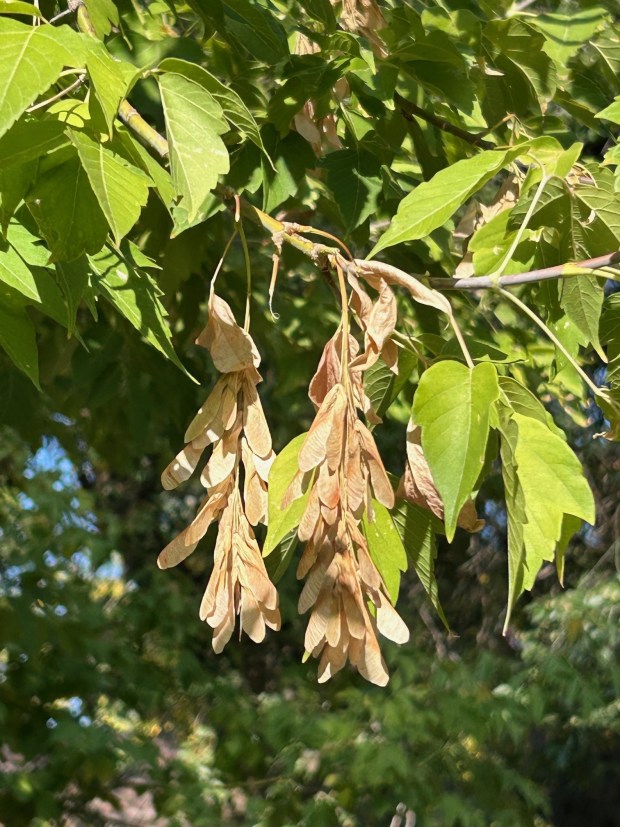
The trees are prolific in the metro area, especially older neighborhoods. Female trees produce small, green-yellow flowers in spring. The best way to identify them is to examine their leaves and seeds on female trees. Notice the leaf arrangement. Boxelder tree leaves are compound in structure, meaning there are three to seven leaflets attached to the mid-vein, plus the leaves are opposite each other along the branches. The fruit, called winged nutlets, ripen in August to September and shed through the fall and winter, which often lead to more boxelder trees.
Boxelder bug controls
The first and most obvious control the bugs is to keep them out of homes and buildings by making sure outside cracks around windows, doors, crevices and any possible openings are repaired, sealed and caulked if needed. If they get inside, they are easy to remove and toss. I use a tissue to grab and crush them. A mild soapy water spray can be used on them, too, which makes for an easy cleanup.
Natural enemies of boxelder bugs are not dependable. Rodents or birds may eat a few, but the red coloration and taste when crushed make them a last resort.
“Use of chemical sprays in homes is risky and not recommended,” said CSU’s O’Connor. Boxelder bugs will not breed inside homes or cause damage other than possibly leaving a little stain on surfaces. Just remove them when seen. Also, “boxelder trees do not require spray controls either since tree damage from bug eating is mostly minimal.”
I notice that groups of boxelder bugs congregate in a sunny mulch area on the southwest side of our yard, so I hose down the mulch every few days and drown them. Be sure to clean up leaves and yard debris around homes to prevent them from nesting through the winter.
Betty Cahill is a freelance writer who speaks and writes about gardening in the Rocky Mountain Region.