


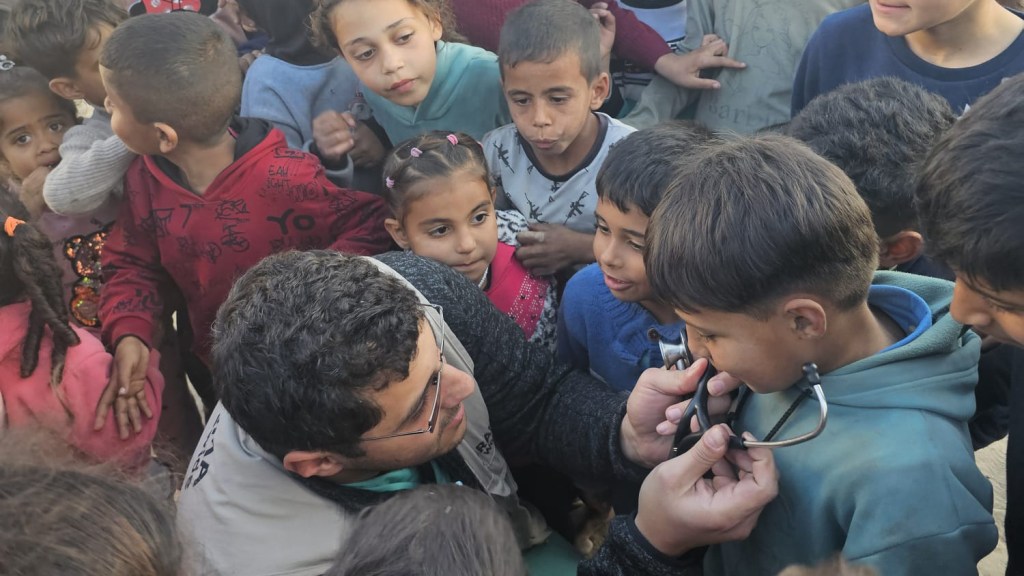
In the days before the latest ceasefire agreement in the Israel-Hamas war, Colorado pediatrician Dr. Mohamed Kuziez learned to estimate how many mass-casualty patients would arrive at a northern Gaza trauma center by how frequently he heard bombs.
“It’s going to be a rough night when you hear bombs dropping every 10 or 15 minutes,” Kuziez said by phone from southern Gaza on Monday. “The sheer scale of trauma, of injury that would happen in one night is overwhelming.”
Kuziez, 34, arrived in Gaza on Jan. 9 as part of a humanitarian mission with Rahma Worldwide and Doctors Against Genocide. He is one of 11 American health care workers who were stuck in northern Gaza for nearly a week after Israeli government officials delayed their departure.
The group planned to return home early last week, but the Israeli agency that oversees humanitarian coordination kept pushing back the timeline, Kuziez said.
Once they were told it was because there were still active operations in the area. Another delay was because checkpoints needed to be set up.
After days of working with Colorado’s congressional delegation and the U.S. Embassy, Kuziez and his colleagues were cleared to head south Monday, just as hundreds of thousands of Palestinians were allowed to return home to northern Gaza. The region now looks like it was hit by a hurricane or massive earthquake, Kuziez said.
Kuziez, a doctor at Children’s Hospital Colorado, said he has wanted to travel to the region to provide medical aid since the war began in October 2023. The experience has been drastically different than his work in metro Denver.
“We get trauma patients at Anschutz but you never expect to be working in an ER and have 30 or 40 patients show up and all need immediate intervention, and if it doesn’t have to look like they’re going to survive you have to stop and move on to the next one,” he said. “As a pediatrician, it’s really hard for me to give up on kids.”
Kuziez spent his days in Gaza working at Patient’s Friends Benevolent Society Hospital, a children’s hospital, and nights at the Al-Ahli Hospital, or Baptist hospital, which served as a staging site for mass casualty events.
He slept at a third hospital where the windows were blown out from the bombing — which meant Kuziez felt every rush of air and vibration in his chest when another bomb exploded.
Kuziez said he’s glad there’s a ceasefire, but it has not stopped the casualties, only slowed them. He recently helped treat a group of 11 children who were injured when they started playing with an unexploded ordinance, not knowing what it was, and it blew up on them.
And while Kuziez was scheduled to be on call at Children’s Hospital on Tuesday, his return home to Colorado is still in flux, and not just because of geopolitical uncertainties. One of Kuziez’s patients in Gaza, a 2-year-old girl with a rare genetic condition, was still waiting to be evacuated.
She is missing a key protein that means her blood can’t clot, and three of her four limbs are getting necrotic, Kuziez said. The medication she needs to survive is not available in Gaza.
“If they tell me staying will help her get out, I will happily stay,” he said.
Get more Colorado news by signing up for our daily Your Morning Dozen email newsletter.