


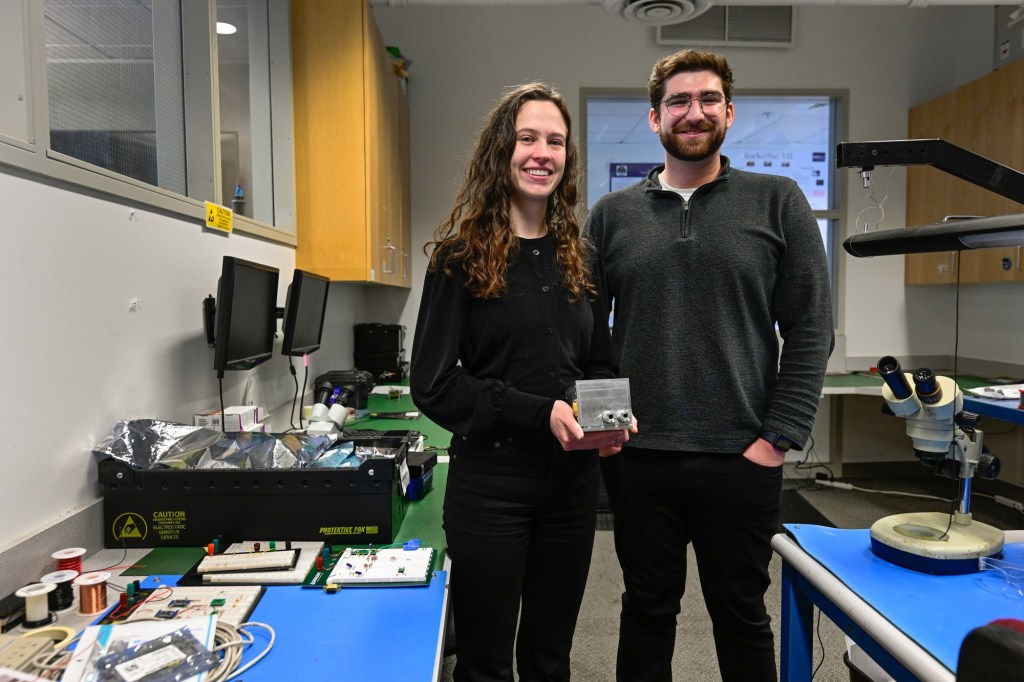
An instrument built by students at the University of Colorado Boulder is finished and awaiting integration on a NASA spacecraft that will launch in early 2025.
The instrument, called STEAM, is one of the instruments that will be integrated on NASA’s PUNCH mission, which is aimed at helping scientists better understand the sun. Mary Hanson, an engineer at the Southwest Research Institute in Boulder, is finishing the last instrument that will be delivered in the next month.
“We’re wrapping things up which is really exciting, getting ready for the final delivery,” Hanson said.
PUNCH is a small NASA explorer that will be in low Earth orbit for about two years. It will study solar wind, which happens every second in space as more than 300,000 tons of material leave the sun and move outward into the solar system. Solar wind creates space weather that can impact power grids, satellites and astronauts and creates the northern lights, or auroras. PUNCH will study the solar wind and the sun to better understand it.
The Southwest Research Institute was selected by NASA to complete the $150 million project.
“I would hope that (PUNCH) would help further our understanding of solar astrophysics,” Sam Honan, CU Boulder undergraduate student and STEAM project manager said. “There’s a lot we still don’t know and a lot to be studied there.”
One of the enduring mysteries about the sun is known as the coronal heating problem. Scientists seek to understand why the outer atmosphere of the sun is so much hotter than the sun’s surface.
“It’s kind of an unsolved problem in solar astrophysics, actually,” Honan said. “You would expect as you go further away from the heat source, which is the center of the sun, it would get colder. That’s true up until about the photosphere, and then suddenly the solar corona goes up into millions of Kelvin and it’s super hot.”
The STEAM instrument will study the coronal heating problem by taking X-rays and collecting data on solar flares and coronal heating, and was delivered to the Southwest Research Institute at the end of October. It’s now awaiting integration on the spacecraft where it will undergo observatory testing, including testing to make sure it can withstand launch and space environment.
Roughly 40 CU Boulder students worked on the STEAM instrument since it began in 2019. Alex Fitzgerald, systems engineer for STEAM and CU Boulder graduate student in aerospace, said it’s been “super cool” to work on a NASA instrument as a student.
“Having this opportunity to work with SwRI and with Space Grant offered some really invaluable, hands-on experience that I don’t think I would’ve gotten just through coursework,” he said.
Hanson is working on finishing a third and final wide-field imager for the PUNCH mission that will look at the sun and take images to find out how the corona is extending toward Earth.
“I hope that PUNCH allows people to learn more about the sun and how solar wind and the corona affect us on Earth because solar wind is what causes auroras and that sort of thing on Earth, so it’s important to understand how the solar wind is moving through space and how it evolves through space to interact with Earth,” Hanson said.