


SEOUL, South Korea — Lee Saedol was the finest Go player of his generation when he suffered a decisive loss, defeated not by a human opponent but by artificial intelligence.
Lee was beaten by AlphaGo, an AI computer program developed by Google’s DeepMind unit. The stunning upset, in 2016, made headlines around the world and looked like a clear sign that artificial intelligence was entering a new, profoundly unsettling era.
By besting Lee, an 18-time world champion revered for his intuitive and creative style of play, AlphaGo had solved one of computer science’s greatest challenges: teaching itself the abstract strategy needed to win at Go, widely considered the world’s most complex board game.
“I am very surprised because I have never thought I would lose,” Lee said at the time in a post-match news conference. “I didn’t know that AlphaGo would play such a perfect Go.”
But the implications of his loss went far beyond the game itself, in which two players compete for territory by placing black and white stones on a gridded board made up of 19 lines by 19 lines. AlphaGo’s victory demonstrated the unbridled potential of AI to achieve superhuman mastery of skills once considered too complicated for machines.
Lee, now 41, retired three years later, convinced that humans could no longer compete with computers at Go. Artificial intelligence, he said, had changed the very nature of a game that originated in China more than 2,500 years ago.
“Losing to AI, in a sense, meant my entire world was collapsing,” he said in a recent interview with The New York Times.
As society wrestles with what AI holds for humanity’s future, Lee is now urging others to avoid being caught unprepared, as he was, and to become familiar with the technology now. He delivers lectures about AI, trying to give others the advance notice he wishes he had received before his match.
“I faced the issues of AI early, but it will happen for others,” Lee said recently at a community education fair in Seoul to a crowd of students and parents. “It may not be a happy ending.”
Since his loss, Lee has become an AI obsessive of sorts, following with rapt if uneasy attention as artificial intelligence delivers one breakthrough after another.
AI has helped chatbots carry on conversations almost indistinguishable from human interaction. It has solved problems that have confounded scientists for decades like predicting protein shapes. And it has blurred the lines of creativity: writing music, producing art and generating videos.
Lee is not a doomsayer. In his view, AI may replace some jobs, but it may create some, too. When considering AI’s grasp of Go, he said it was important to remember that humans both created the game and designed the AI system that mastered it.
What he worries about is that AI may change what humans value.
“People used to be in awe of creativity, originality and innovation,” he said. “But since AI came, a lot of that has disappeared.”
Lee started playing Go at the age of 5 under the guidance of his father, a schoolteacher and enthusiast of the game. His family lived on Bigeumdo, an island off the southwest coast of the Korean Peninsula inhabited by around 3,600 people.
His immense talent was apparent from the start. He quickly became the best player of his age not only locally but across all of South Korea, Japan and China. He turned pro at 12.
By the time he was 20, Lee had reached 9-dan, the highest level of mastery in Go. Soon, he was among the best players in the world, described by some as the Roger Federer of the game.
“He was an idol, he was a star,” said Lee Hajin, a former professional Go player. “Everyone looked up to him.”
As Lee Saedol’s standing was growing, Go started garnering interest from a new audience: computer scientists.
Go posed a tantalizing challenge for AI researchers. The game is exponentially more complicated than chess, with it often being said that there are more possible positions on a Go board (10 with more than 100 zeros after it, by many mathematical estimates) than there are atoms in the universe.
The breakthrough came from DeepMind, which built AlphaGo using so-called neural networks: mathematical systems that can learn skills by analyzing enormous amounts of data. It started by feeding the network 30 million moves from high-level players. Then the program played game after game against itself until it learned which moves were successful and developed new strategies.
By late 2015, AlphaGo had defeated a three-time European Go champion five consecutive times in a closed-door match.
Then, Lee was approached by Lee Hajin, who was working at the International Go Federation, with a proposal for a public match, with a $1 million prize for beating AlphaGo.
Lee Saedol said he accepted the offer without much thought, figuring it would be “fun.”
“But fun with the presumption that I was going to win,” he said. “The possibility of losing didn’t occur to me.”
The best-of-five match, played in Seoul, was a spectacle. In South Korea, where millions of people play Go and Lee is a celebrity, the showdown led nightly television broadcasts. More than 200 million people watched, with huge audiences in China and Japan.
During the matches, a DeepMind engineer sat across from Lee and placed the stones as relayed to him by AlphaGo. Lee said not having a true human opponent was disconcerting. AlphaGo played a style he had never seen, and it felt odd to not try to decipher what his opponent was thinking and feeling. The world watched in awe as AlphaGo pushed Lee into corners and made moves unthinkable to a human player.
“I couldn’t get used to it,” he said. “I thought that AI would beat humans someday. I just didn’t think it was here yet.”
AlphaGo won 4 of 5 matches. Lee Sang Hoon, his older brother and a professional Go player, remembered thinking: “This can’t be.”
“It was shocking,” said his brother, who continues to play as a professional. Like other pros, he now trains with AI systems that continue to learn and improve.
“Pro players are studying how these algorithms work and are trying to close the gap,” his brother said. “But we are a long way away.”
AlphaGo’s victory “was a watershed moment in the history of AI,” said Demis Hassabis, DeepMind’s CEO, in a written statement. It showed what computers that learn on their own from data “were really capable of,” he said.
Lee had a hard time accepting the defeat. What he regarded as an art form, an extension of a player’s own personality and style, was now cast aside for an algorithm’s ruthless efficiency.
“I could no longer enjoy the game,” he said. “So I retired.”
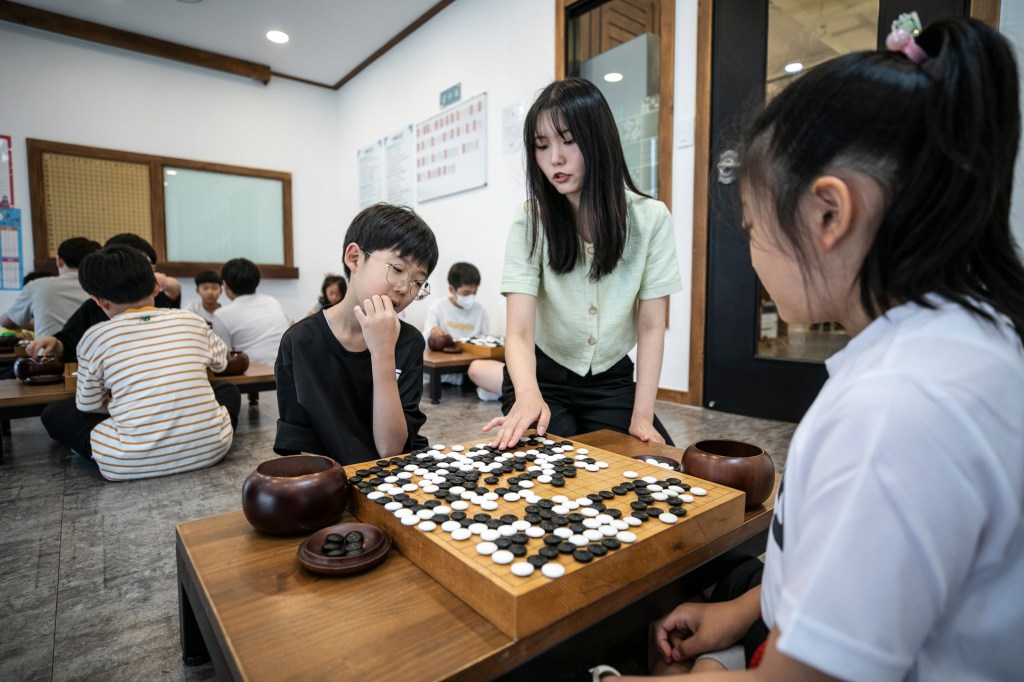
Lee has kept one foot in the Go world. He has written several books, including an autobiography and a series about his famous matches. He has created Go-inspired board games. He founded a Go academy for children with about a dozen branches across the country.
But AI dominates his thoughts, partly because of the ambivalence he feels about the pros and cons, but also because it’s a subject that hits close to home.
His 17-year-old daughter is in her final year of high school. When they discuss what she should study at university, they often consider a future shaped by AI.
“We often talk about choosing a job that won’t be easily replaceable by AI or less impacted by AI,” he said. “It’s only a matter of time before AI is present everywhere.”
This article originally appeared in The New York Times.
Get more business news by signing up for our Economy Now newsletter.