


A new artificial intelligence program will help identify wildfires as small as an acre by scanning images taken by weather satellites orbiting about 22,000 miles above the Earth’s surface.
The AI program, developed by the National Oceanic and Atmospheric Administration and recently tested in Boulder, could dramatically cut the amount of time between identifying a fire and responding — minutes and hours that are critical to containing a blaze.
Called the Next Generation Fire System, NOAA officials say it can process the deluge of data from the satellites — which capture images as frequently as every 30 seconds — and detect heat from fires smaller than a football field. The program then flags potential new fires to a dashboard so humans can check the images and verify the existence of a fire.
While humans are great at detecting a new fire from satellite images, they can’t process the firehose of data as quickly and easily as the AI program, said Mike Pavolonis, NOAA Satellites’ Wildland Fire Program manager.
“The first step in wildland fire management is to know the fire is there,” he said.

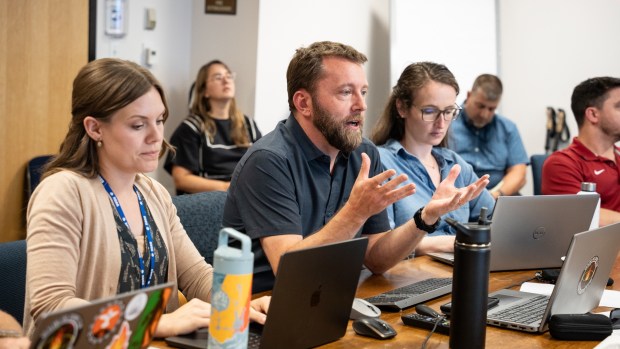
Last month, the Next Generation Fire System underwent its first significant test run when fire weather forecasters, state wildfire managers and researchers gathered in Boulder to run through simulated fire scenarios using the new tool. NOAA’s Fire Weather Testbed is based in the agency’s Boulder office and is aimed at integrating new technology in fire responses and connecting fire experts across the country.
The tests were a success, said Zach Tolby, the Fire Weather Testbed manager. The Next Generation Fire System has been online for about a year in experimental form, he said, but agencies are now beginning to use it in real time.
The tool provides a GPS location of the suspected fire, which is more accurate than trying to locate where smoke is originating from, Tolby said. It also provides information about fuels in the area and potential weather that could affect fire behavior.
The program will be especially important in areas with fewer people and resources, Tolby said.
“In populated areas, 911 gets called pretty quickly when there is new smoke,” he said. “But that’s not the case in more rural areas.”
Advanced tools to help identify and fight fires are critical as wildfires across the West become larger and more devastating due to drought, climate change and decades of fire suppression. In Colorado, 20 of the state’s largest wildfires ignited since the start of the new millennium, according to the Colorado Division of Fire Prevention and Control.
Similarly, all of the most destructive fires in state history burned in the last 12 years, including the 2021 Marshall fire.

“Wildland fire is a growing crisis and wildland fire managers are in need of better tools,” Pavolonis said. “That’s really the role of tech: To make decision-making more efficient and effective for humans, who are making really big decisions about people and resources.”
The NOAA’s artificial intelligence program is one of several projects across the West that leverage the power of AI to detect and fight wildfires.
Several governments and companies in Colorado contract with Pano AI, which installs a network of cameras and uses AI to monitor the video feeds for smoke. Xcel Energy Colorado, the Telluride Fire Protection District, the Aspen Fire Department and others have hired the company.
State lawmakers in 2023 introduced a bill that would have set aside $2 million for camera systems that detect wildfires using AI, but the bill failed.
The federal government in recent years has poured millions of dollars into new technologies to predict, detect and fight fires. Funding for the Fire Weather Testbed and the Next Generation Fire System was part of a $5 billion allocation for wildland fire issues in the Bipartisan Infrastructure Law.
“Rising temperatures, declining snowpack and frequent droughts are all leading to a dramatic surge in wildfire frequency and severity across the United States,” NOAA Administrator Rick Spinrad said in a news release about the Bipartisan Infrastructure Law funding. He said the investments would help develop new tools to improve the accuracy of forecasts as well as “assist local officials’ decision-making and communicate vital public safety information to more people more quickly.”
The NOAA for decades has used weather satellites to help detect wildfires, but the technology has advanced rapidly over the last few years and is becoming more useful in times of fire, Pavolonis said.
It is also creating an AI program that can detect lightning strikes — and predict where lightning might strike next and whether it will spark a fire in a given area — based on the weather, fuels and other factors.
“The rate at which progress has been made on this has been pretty exciting,” Pavolonis said.
Get more Colorado news by signing up for our Mile High Roundup email newsletter.
Originally Published: