


On a hot summer day in Oak Ridge, Tennessee, dozens of men removed pipes, asbestos and hazardous waste while working to decontaminate a nuclear facility and prepare it for demolition.
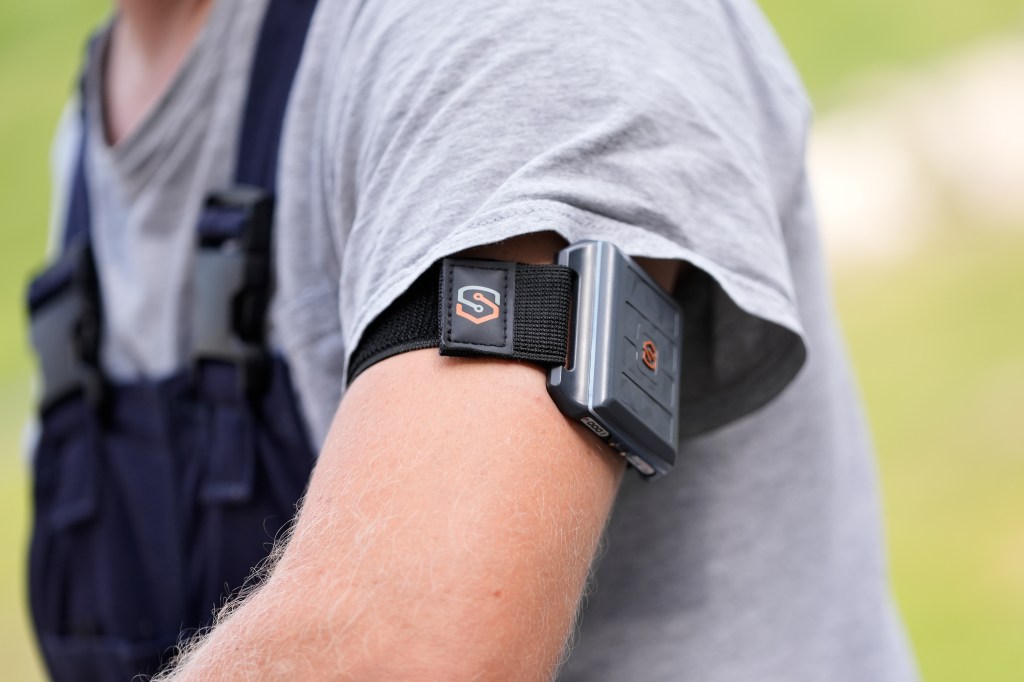
Dressed in head-to-toe coveralls and fitted with respirators, the crew members toiling in a building without power had no obvious respite from the heat. Instead, they wore armbands that recorded their heart rates, movements and exertion levels for signs of heat stress.
Stephanie Miller, a safety and health manager for a U.S. government contractor doing cleanup work at the Oak Ridge National Laboratory, watched a computer screen nearby. A color-coding system with little bubbles showing each worker’s physiological data alerted her if anyone was in danger of overheating.
“Heat is one of the greatest risks that we have in this work, even though we deal with high radiation, hazardous chemicals and heavy metals,” Miller said.
As the world experiences more record high temperatures, employers are exploring wearable technologies to keep workers safe. New devices collect biometric data to estimate core body temperature – an elevated one is a symptom of heat exhaustion – and prompt workers to take cool-down breaks.
The devices, which were originally developed for athletes, firefighters and military personnel, are getting adopted at a time when the Atlantic Council estimates heat-induced losses in labor productivity could cost the U.S. approximately $100 billion annually.
But there are concerns about how the medical information collected on employees will be safeguarded. Some labor groups worry managers could use it to penalize people for taking needed breaks.
“Any time you put any device on a worker, they’re very concerned about tracking, privacy, and how are you going to use this against me,” said Travis Parsons, director of occupational safety and health at the Laborers’ Health and Safety Fund of North America. “There’s a lot of exciting stuff out there, but there’s no guardrails around it.”
Vulernable to heat
At the Tennessee cleanup site, the workers wearing heat stress monitors made by Atlanta company SlateSafety are employed by United Cleanup Oak Ridge. The company is a contractor of the U.S. Department of Energy, which has rules to prevent on-the-job overheating.
But most U.S. workers lack protections from extreme heat because there are no federal regulations requiring them, and many vulnerable workers don’t speak up or seek medical attention. In July, the Biden administration proposed a rule to protect 36 million workers from heat-related illnesses.
From 1992 to 2022, 986 workers died from heat exposure in the U.S., according to the Environmental Protection Agency. Experts suspect the number is higher because a coroner might not list heat as the cause of death if a sweltering roofer takes a fatal fall.
Setting occupational safety standards can be tricky because individuals respond differently to heat. That’s where the makers of wearable devices hope to come in.
How wearable heat wear works
Employers have observed workers for heat-related distress by checking their temperatures with thermometers, sometimes rectally. More recently, firefighters and military personnel swallowed thermometer capsules.
“That just was not going to work in our work environment,” Rob Somers, global environment, health and safety director at consumer product company Perrigo, said.
Instead, more than 100 employees at the company’s infant formula plants were outfitted with SlateSafety armbands. The devices estimate a wearer’s core body temperature, and a reading of 101.3 degrees triggers an alert.
Another SlateSafety customer is a Cardinal Glass factory in Wisconsin, where four masons maintain a furnace that reaches 3000 degrees Fahrenheit.
“They’re right up against the face of the wall. So it’s them and fire,” Jeff Bechel, the company’s safety manager, said.
Cardinal Glass paid $5,000 for five armbands, software and air-monitoring hardware. Bechel thinks the investment will pay off; an employee’s two heat-related emergency room visits cost the company $15,000.
Another wearable, made by Massachusetts company Epicore Biosystems, analyzes sweat to determine when workers are at risk of dehydration and overheating.
“Until a few years ago, you just sort of wiped (sweat) off with a towel,” CEO Rooz Ghaffari said. “Turns out there’s all this information packed away that we’ve been missing.”
Research has shown some devices successfully predict core body temperature in controlled environments, but their accuracy remains unproven in dynamic workplaces, according to experts. A 2022 research review said factors such as age, gender and ambient humidity make it challenging to reliably gauge body temperature with the technology.
The United Cleanup Oak Ridge workers swathed in protective gear can get sweaty even before they begin demolition. Managers see dozens of sensor alerts daily.
Laborer Xavier Allison, 33, was removing heavy pieces of ductwork during a recent heat wave when his device vibrated. Since he was working with radioactive materials and asbestos, he couldn’t walk outside to rest without going through a decontamination process, so he spent about 15 minutes in a nearby room which was just as hot.
“You just sit by yourself and do your best to cool off,” Allison said.
The armband notifies workers when they’ve cooled down enough to resume work.
“Ever since we implemented it, we have seen a significant decrease in the number of people who need to get medical attention,” Miller said.
Collecting personal data
United Cleanup Oak Ridge uses the sensor data and an annual medical exam to determine work assignments, Miller said. After noticing patterns, the company sent a few employees to see their personal physicians, who found heart issues the employees hadn’t known about, she said.
At Perrigo, managers analyze the data to find people with multiple alerts and speak to them to see if there’s “a reason why they’re not able to work in the environment,” Somers said. The information is organized by identification numbers, not names, when it goes into the company’s software system, he said.
Companies keeping years of medical data raises concerns about privacy and whether bosses may use the information to kick an employee off a health plan or fire them, said Adam Schwartz, privacy litigation director at the Electronic Frontier Foundation.
“The device could hurt, frankly, because you could raise your hand and say ‘I need a break,’ and the boss could say, ‘No, your heart rate is not elevated, go back to work,’” Schwartz said.
To minimize such risks, employers should allow workers to opt in or out of wearing monitoring devices, only process strictly necessary data and delete the information within 24 hours, he said.
Wearing such devices also may expose workers to unwanted marketing, Ikusei Misaka, a professor at Tokyo’s Musashino University, said.
A partial solution
The National Institute for Occupational Safety and Health advises employers to institute a plan to help workers adjust to hot conditions and to train them to recognize signs of heat-related illness and to administer first aid. Wearable devices can be part of efforts to reduce heat stress, but more work needs to be done to determine their accuracy, said Doug Trout, the agency’s medical officer.
The technology also needs to be paired with access to breaks, shade and cool water, since many workers, especially in agriculture, fear retaliation for pausing to cool off or hydrate.
“If they don’t have water to drink, and the time to do it, it doesn’t mean much,” Juanita Constible, senior advocate at the Natural Resources Defense Council, said. “It’s just something extra they have to carry when they’re in the hot fields.”
___
Yuri Kageyama in Tokyo contributed to this report.
Get more business news by signing up for our Economy Now newsletter.