


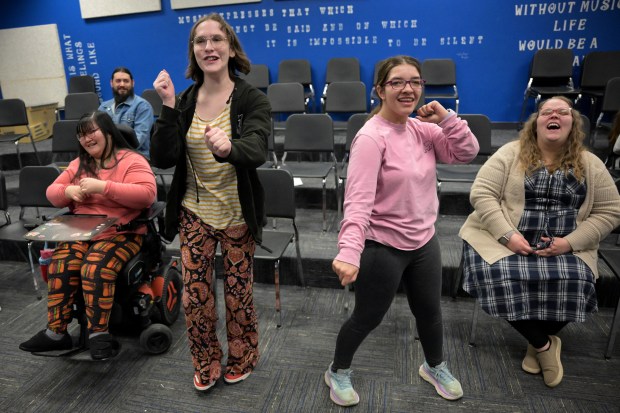
Last year, Kennady Schneider couldn’t take gym class or participate in physical activities on field trips with her classmates, the risk too great that the noise and heat could trigger a seizure.
Kennady, now 19 and a senior at Columbine High School in Jefferson County, has a particularly difficult-to-treat form of epilepsy that has caused multiple seizures a day since she was 5. Some lasted as long as 20 minutes, leaving her depleted and ultimately causing other disabilities, including vision problems and some intellectual limitations.
Medications and a surgery cutting the area where the two halves of her brain join helped some, but not enough to give the teen the quality of life she’d hoped for, said Heidi Schneider, her mother. So Schneider decided to try a new use of an old technology: allowing doctors to implant electrodes in her daughter’s brain.
Kennady is the youngest person in Colorado to receive deep-brain stimulation for epilepsy. The treatment, which involves implanting small electrodes into selected parts of the brain, has been an option for patients with Parkinson’s disease for more than 20 years. A trial in 2015 found the procedure also could be effective for adults with the most common form of epilepsy.
She had the surgery at Children’s Hospital Colorado in July, with adjustments since then changing the intensity and direction of the electricity. The device lasts for decades and doctors can adjust it without reopening the skull.

Now, Kennady has fewer seizures, and the ones she has are shorter and less intense, Schneider said. While they still take precautions so she won’t fall and hurt herself, she and Kennady’s stepfather feel more confident taking her out. They’re even planning a two-week trip to the Mediterranean later this year.
“Her brain has kind of calmed down,” Schneider said. “We have a lot of hope that this will open doors for her.”
The treatment most likely won’t stop her seizures altogether, but Kennady’s less concerned with that than with her immediate goals, like learning to swim (with someone nearby in case she were to start seizing), figuring out what she wants to do for a career and learning more skills so she can live independently.
“I just want to learn to do my own hair,” Kennady said. It’s a skill she practices each morning in her special education classroom at Columbine.
Kennady has Lennox-Gaustaut syndrome, which causes seizures throughout the brain and intellectual disability. It’s one of many things that can cause epilepsy, which is an umbrella term for recurring seizures. People who have epilepsy vary in how severely the seizures impact their lives, what triggers a seizure and what treatments work for them.
Patients with Lennox-Gaustaut syndrome tend to start having seizures early in life, and generally experience more severe effects than people with some other types of epilepsy.
Because Kennady’s seizures aren’t coming from just one part of the brain, the team at Children’s placed the electrodes in a “relay station” that sends signals between the rest of the body and the brain, influencing electrical activity in a larger area, said Dr. Allyson Alexander, an assistant professor of pediatric neurosurgery at the hospital who spoke with the family’s permission.

Researchers don’t know exactly why deep brain stimulation helps some people with epilepsy, but the leading theory is that it keeps certain parts of the brain from firing up together in unhealthy ways, Alexander said. Since two regions firing at the same time strengthens their connection, the hope is that disrupting that process will weaken the “epileptic network,” essentially causing the brain to forget how to have seizures over a period of years, she said.
“You’re helping the brain unlearn (the mistaken idea) that that epileptic network is a good thing,” she said.
Brain surgery isn’t a first-line option for treating epilepsy, but it can be a safe and effective choice for people who haven’t found relief from medications and less-invasive procedures, Alexander said. Deep-brain stimulation doesn’t cure everyone, but about 15% of adults who’ve had it for epilepsy eventually become free of seizures. The data about outcomes in children and teens isn’t as robust, but Kennady has a chance of living without seizures someday, she said.
“It’s not a high chance, but it’s not a one-in-a-million chance,” Alexander said.
Kennady still has to take 19 pills each day, but she’s used to it, and said her epilepsy doesn’t stop her from doing the things she wants to, like performing as Ariel in the special education program’s production of “The Little Mermaid” and accepting the crown for the quieter homecoming dance the district puts on for students with sensory needs.
She performed some scenes as Ariel from a wheelchair, which she uses to avoid falling if she has a seizure, and wore headphones to the homecoming assembly just in case the noise could trigger one.

“I care about my safety,” she said.
Dr. Alan Weintraub, Kennady’s stepfather, said she has become more social and emotionally responsive since the stimulation began. In the past, when she had to take “rescue medication” to stop seizures that weren’t resolving on their own, she’d just sit and stare for a while afterward, he said.
“Now, she’s very in tune with what’s going on,” Weintraub said.
Her main teacher, Anna Wright, also noticed changes. Last year, Kennady often had to go home early multiple times a week because she was so exhausted by her seizures. Now, she only has a seizure that severe roughly once a month, allowing her to stay in the classroom and spend more time with her friends, she said.
Kennady’s also taking physical education this semester for the first time in her high school career. Previously, the possibility that a loud noise would set off a seizure made it unsafe for her, but now that the seizures are less intense, she can play sports with her classmates, Wright said.
“She’s able to come out of (milder seizures) and not be so tired and out of it,” she said. “She’s just able to experience school more.”
Sign up for our weekly newsletter to get health news sent straight to your inbox.