


By ALEXA ST. JOHN
DETROIT (AP) — President Donald Trump’s 25% tariffs on autos not made in the U.S. and certain auto parts are sending more tremors through an industry already being pummeled by steel and aluminum import duties and on-again, off-again 25% levies on Canada and Mexico. The new tariffs, announced Wednesday, are likely to jack up new vehicle prices and will also impact the used car market.
Trump has been itching to tax foreign autos for years. In his first term, he declared auto imports a threat to national security giving him the authority to impose tariffs on them.
It’s the latest in a number of auto industry maneuvers by Trump during his first weeks back in the White House. Auto companies are also navigating the reversal of fuel economy standards, dialed down greenhouse gas emission standards and a host of electric vehicle policy rollbacks.
-
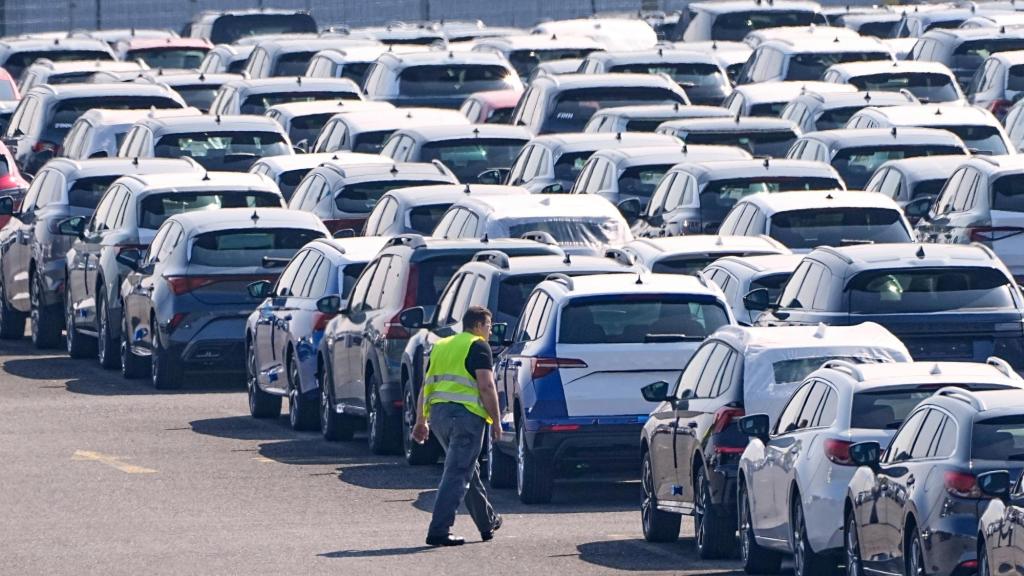
New Toyota vehicles are stored at the Toyota Logistics Service Inc., their most significant vehicle imports processing facility in North America, at the Port of Long Beach in Long Beach, Calif., Wednesday, March 26, 2025. (AP Photo/Damian Dovarganes)


1 of 3
New Toyota vehicles are stored at the Toyota Logistics Service Inc., their most significant vehicle imports processing facility in North America, at the Port of Long Beach in Long Beach, Calif., Wednesday, March 26, 2025. (AP Photo/Damian Dovarganes)
Here’s what to know.
What makes tariffs so difficult for the auto industry to grapple with?
As automakers expanded globally, so too did their production, manufacturing and supply chains. Responding to the rapidly shifting U.S. trade policy has become complex and confusing.
It would be impossible for auto manufacturers to reroute the sourcing overnight of thousands of parts that are imported to the U.S., and uprooting their assembly operations would take years. The network of auto manufacturing and supply are planned and developed over a span of years, and the industry may suffer collateral damage in Trump’s escalating trade wars.
“It adds to the uncertainty facing all automakers as the industry’s supply chain is inherently global and has optimized around moving components across national borders where free trade agreements have existed in the past,” said John Paul MacDuffie, professor of management at the University of Pennsylvania.
That means auto companies are likely to feel pain from the tariffs at different levels, said Sam Fiorani, analyst at AutoForecast Solutions, which studies the industry.
“While European manufacturers chiefly deal in luxury vehicles and their buyers can afford some price adjustments, it’s the companies like Toyota, Mazda, and Subaru who import large percentages of their fleets that will take a beating,” Fiorani said.
“Throwing tariffs on the parts of vehicles built in Mexico and Canada that aren’t sourced from the United States will hurt the profits of General Motors, Stellantis, and Ford over the next few quarters, costing them billions,” he added.
What does this mean for car buyers and new car prices?
New vehicles were selling for over $47,000 last month on average, according to auto-buying resource Edmunds. Tariffs could drive new car prices up by several thousand dollars, industry analysts say, though it is difficult to know by exactly how much given the scattershot nature of Trump’s proposed trade policies during his short time in office.
Those buying cars in the U.S. looking for deals should should research which brands have more supply on dealership lots, the result of less popular models or brands stacking up. Last month, top-selling auto companies in the U.S. averaged 58 days’ supply of inventory, Edmunds says.
Ford, Stellantis and Hyundai had some of the most inventory available, while Toyota, Honda and Nissan had some of the least.
Automakers and their suppliers are only now recovering from years of instability brought on by pandemic-forced production halts, a sweeping semiconductor shortage and low inventory on dealership lots. That meant prices were sky-high, incentives were low and few deals were to be had.
During the peak of the pandemic, consumers still bought vehicles at high prices. But the piled-on tariffs could put new vehicles out of reach for many would-be buyers, especially given rising indications of potentially broader inflation ahead throughout the economy.
“Starting almost immediately, consumers will see their already expensive new vehicles cost hundreds to thousands more and those prices will escalate even more when the supplies of many key vehicles dwindle,” Fiorani said. “Imagine the price rises during the semiconductor shortage and stretch it out across every brand and manufacturer. The trickle-down effect will put smaller suppliers out of business and send many workers onto unemployment.”
What about used cars?
Tariffs, raising new vehicle prices, are likely to send buyers to the used market. But with limited used inventory, an influx of buyers could rock used car prices, too.
Lease penetration, or the number of vehicle transactions that are leases, has averaged around 30% or so over the past 10 years, according to Edmunds data.
But the industry saw low rates of leasing — nearly half the norm — particularly between May 2022 and January 2023. Fewer leased vehicles typically means fewer two- or three-year-old vehicles being put on the used-car market.
That suggests demand may outstrip supply just as more buyers, priced out of the new car market, start shopping for used vehicles.
How has the industry responded?
Governor Matt Blunt, president of the American Automotive Policy Council, which represents U.S. automakers, said in a statement that manufacturers supported Trump’s efforts to boost domestic auto manufacturing and are committed to working with the administration.
“In particular, it is critical that tariffs are implemented in a way that avoids raising prices for consumers and that preserves the competitiveness of the integrated North American automotive sector that has been a key success of the President’s USMCA agreement,” he added.
The United Auto Workers labor union too applauded Trump for ending what it called a “free trade disaster.”
“Ending the race to the bottom in the auto industry starts with fixing our broken trade deals, and the Trump administration has made history with today’s actions,” UAW President Shawn Fain said in a statement. “These tariffs are a major step in the right direction for autoworkers and blue-collar communities across the country, and it is now on the automakers, from the Big Three to Volkswagen and beyond, to bring back good union jobs to the U.S.”
But Jennifer Safavian, president and CEO of Autos Drive America, which represents international auto manufacturers, denounced the tariffs.
“At a time when cost is the number one concern for American car buyers, U.S. automakers are working to provide a range of affordable vehicles for consumers,” Safavian’s said. “The tariffs imposed today will make it more expensive to produce and sell cars in the United States, ultimately leading to higher prices, fewer options for consumers, and fewer manufacturing jobs in the U.S.”
Associated Press reporter Paul Wiseman contributed reporting from Washington, D.C.
Alexa St. John is an Associated Press climate reporter. Follow her on X: @alexa_stjohn. Reach her at ast.john@ap.org.
The Associated Press’ climate and environmental coverage receives financial support from multiple private foundations. AP is solely responsible for all content. Find AP’s standards for working with philanthropies, a list of supporters and funded coverage areas at AP.org.
Originally Published: