

Drought and long, hot summer days are sucking Western Colorado’s rivers dry, parching farm fields and fueling the massive wildfires proliferating across the region.
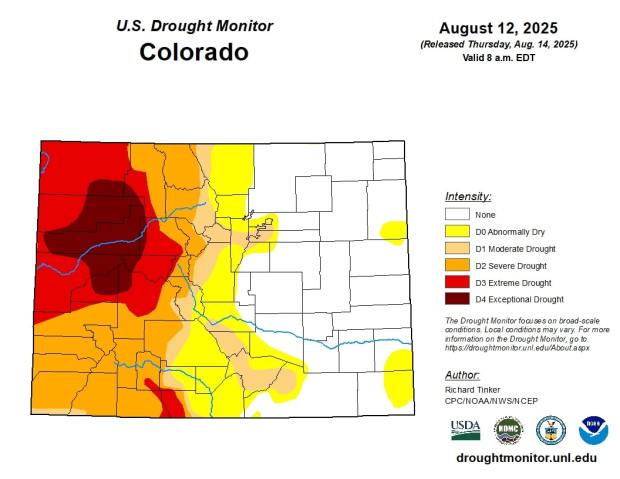
A chunk of northwestern Colorado in the last week plunged into exceptional drought — the most dire category recorded by the U.S. Drought Monitor. The swath of affected land represents 7% of the state and covers most of Garfield and Rio Blanco counties, as well as parts of Moffat, Mesa, Delta, Routt and Pitkin counties.
“Northwestern Colorado is the epicenter of drought in the whole country right now,” said Russ Schumacher, Colorado’s state climatologist and the director of the Colorado Climate Center. “It’s about as bad as it gets.”
Exceptional drought is expected to occur once every 50 years, Schumacher said. So far this summer, the afternoon monsoon rains that provide relief have been largely absent from the Western Slope.
The higher-than-normal temperatures and a lack of rain have sapped the rivers in the Western half of Colorado. Streamflows statewide are at only half of the median recorded between 1991 and 2020, according to National Water and Climate Center data.
The lack of water has limited fishing and rafting opportunities, reduced agricultural irrigation and threatened river environments.
For the Western Slope’s water managers, low streamflows mean weekly calls and intense coordination to ensure the water that is available is allocated efficiently and with maximum benefit.
“It’s been a tricky year to coordinate and make sure people have the water they need, because there’s really not enough to go around,” said Sam Calahan, a water resources data specialist for the Colorado River District.
Drought across the state
Nearly half of Colorado is experiencing some level of drought, according to new data released Thursday by the U.S. Drought Monitor. More than 1.4 million people live in that drought-impacted area, which encompasses the entire western half of the state, parts of metro Denver and some areas of southern Colorado.

Drought reigns despite near-normal winter snowpack levels across much of the state earlier this year. That’s due to a warm end to winter, followed by an unusually dry and warm spring and summer, Schumacher said.
When afternoon storms have occurred, they’ve largely been dry storms — with lightning but no rain.
“It’s just been dry, dry, dry,” he said.
The lightning storms have sparked five wildfires that are burning on the Western Slope, consuming hundreds of square miles and destroying five homes.
Data from the National Oceanic and Atmospheric Administration compiled by Climate Central show that average summer temperatures in Colorado have risen between 2 and 4 degrees since 1970. The Western Slope has seen the greatest warming, according to the data.
Those warmer temperatures — fueled in part by greenhouse gases from human development — make the air drier, which then pulls more water from soils, rivers and plants, Schumacher said. Drier plants make more combustible fuel for wildfires.
“It takes what would’ve been a drought anyway and makes it worse,” he said.
Low, low river flows
This summer has been one of the driest on record for the state’s critical Colorado River basin, similar to 2018 and 2021, said Calahan of the Colorado River District. Drought in those years made the Colorado River look more like a creek than a river and prompted a 120-mile-long fishing ban on its mainstem.
“(This year) is not record bad, but it’s pretty close and pretty dire,” Calahan said.
Streamflow in the basin is worst on its western flank and best on its eastern side near the headwaters, he said. Much of the water near the headwaters, however, is diverted under the Continental Divide to Front Range communities.
The district is speaking weekly with irrigators across the region to best divvy up the water that remains. Low flows are being supplemented by releases from reservoirs.
While most of the reservoirs used by Front Range water providers filled up during the spring runoff, those used by the Western Slope were more of mixed bag, Calahan said.
Green Mountain Reservoir — on the Blue River southeast of Kremmling — did not fill, and the river district will now send water from its upstream Wolford Mountain Reservoir to supplement Green Mountain.
“If we have another year like this next year, and Wolford gets drawn down farther, then we’re in a precarious spot,” Calahan said.
A lack of water in the Eagle River near Vail prompted local water authorities to warn of a potential coming water shortage. Flows on the river near Avon were about half of normal — and the third-lowest recorded on the stream gauge’s 26-year record, said Siri Roman, the general manager of the Eagle River Water and Sanitation District.
District leadership urged people in the district — which includes Vail, Avon and eastern Eagle County — to use less water, especially outdoors.
“We’d rather see that water in the river than on your lawns,” Roman said.
Thirteen of the 14 stream gauges with historic data in the Upper San Juan basin were reporting flows below or extremely below normal on Wednesday. The Animas River in Durango was flowing at 153 cubic feet per second — a fraction of the median of 499 cfs for the day across 113 years of data, and close to the historic low for that date of 137 cfs.
“You can look at it and just see how much of the streambed is out of the water and see some of the gravel bars,” said Steve Wolff, the general manager of the Southwestern Water Conservation District.
Several stream gauges in the basin were recording record daily lows, like the San Juan River in Pagosa Springs and on Vallecito Creek.
“We’re in this long, dry period, and it has impacted everyone in this community,” Wolff said.

Yampa River basin struggles, too
On the opposite side of the state, the Yampa River basin, too, is struggling. The river above Stagecoach Reservoir was flowing at less than half of the 36-year median.
Low flows forced Steamboat Springs officials on Thursday to close the section of river that flows through town to all recreation indefinitely, including for commercial operations, tubing, swimming and fishing. Warm water stresses fish populations, and officials hope to lessen the toll on aquatic life by keeping people out of the river.
The lack of water also prompted state water managers in late July to mandate that people with more junior water rights use less water from the river system. The main stem of the Yampa River below Stagecoach Reservoir has been placed on call only four times: 2018, 2020, 2021 and this year.
A lack of rain and hot temperatures meant everything in the basin happened about a month early, said Holly Kirkpatrick, the public information officer for the Upper Yampa Water Conservancy District. High flows from mountain runoff dropped in May, instead of June, and water temperatures started to spike in June, instead of July.
In dry years, the district releases water from Stagecoach Reservoir to keep enough water in the river for environmental health. The district began those releases this year on June 27 — the earliest ever — and may deplete the amount of water available for environmental releases by mid-September.
“For probably the first time, we’re looking at not having enough water to support the health of the river for the rest of the season,” Kirkpatrick said.
The outlook for the fall across Colorado is much of the same — drier and warmer than usual, Schumacher said.
There’s a sliver of hope, however, for the return of monsoon conditions at the end of August — or at least some cloud cover.
“It won’t be a drought-busting rainstorm, but at least some more humidity and some clouds,” he said.
Get more Colorado news by signing up for our Mile High Roundup email newsletter.