


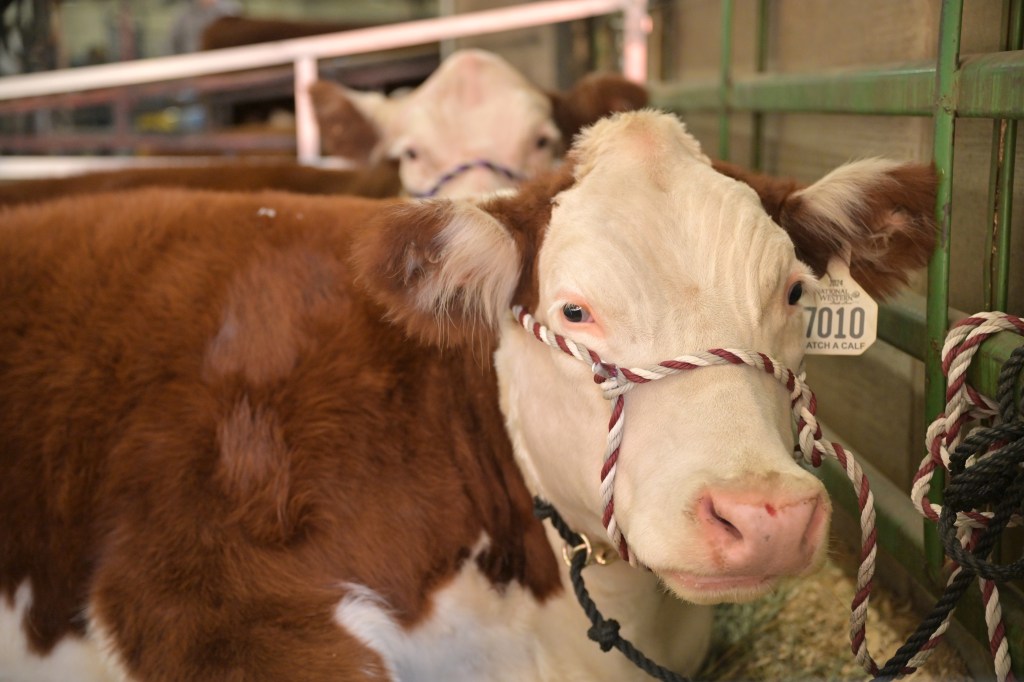
Cattle’s soundless belches are sending millions of pounds of greenhouse gases into the atmosphere and U.S. Sen. Michael Bennet hopes changing their diet will limit those expulsions.
Bennet this week introduced a bill to study cattle emissions more closely, research new solutions and help ranchers integrate methane-reducing practices into their production.
Cattle, goats and sheep digest their food by fermenting it in their stomachs, which breaks down the food over time. A byproduct of the process is methane — a potent greenhouse gas that becomes trapped in the atmosphere and contributes to climate change.
Contrary to popular belief, cattle spew nearly all of the methane into the atmosphere via burps — not farts.
Agriculture accounts for 10% of all greenhouse emissions in the U.S. and cattle account for more than a quarter of those emissions, according to the U.S. Environmental Protection Agency. When looking at methane alone — a less common but more harmful greenhouse gas than carbon dioxide — livestock create one-third of all human-caused methane emissions.
Each animal emits between 154 to 264 pounds of methane every year, according to the EPA. Collectively, the 1.5 billion cattle raised for meat production across the globe emit more than 231 billion pounds of methane every year, not including emissions from dairy cows.
“Colorado has led the nation by taking important steps to limit greenhouse gas emissions, including methane — and our state’s family farmers and ranchers play a crucial role in that effort,” Bennet said in a news release announcing the Emit Less Act. “This bill will help Colorado’s cattlemen and livestock producers access every available tool to voluntarily reduce methane emissions, expand research into this field, and improve the sustainability of their farms and ranches.”
Scientists have known for hundreds of years that livestock produces methane. Still, not enough research has been done into exactly how much methane cattle exhale, what factors influence that amount and how to reduce it, said Kim Stackhouse-Lawson, director of AgNext at Colorado State University and a professor of animal science who studies cattle emissions.
There are no thoroughly studied solutions to reduce methane emissions except for reducing the number of cattle in production, she said.
“Yet,” she added.
That’s why she and her team carefully measure burps from hundreds of animals in feed pens and pastures across Colorado. Researchers with the AgNext program installed feed bins that track how much feed each animal has consumed and separate machines that measure how much methane they are exhaling.
The researchers use alfalfa pellets — a tasty treat for cattle — to lure the animals toward the gas measuring machine. While a cow has its head near the machine to nab the pellets, the machine gently sucks the air from near the animal’s face to measure the gases it is emitting.
Researchers have been surprised by the variance in methane levels from animal to animal, Stackhouse-Lawson said. Emissions vary by size, the amount they eat, what they eat, whether they are confined or grazing and their surrounding climate, she said.
Some beef companies have already tweaked their animals’ diets to reduce methane. Burger King in 2020 announced it would add lemon grass to feed for the cattle it uses to limit methane emissions. A Canadian farmer last year started breeding cattle meant to emit less methane. Others have touted seaweed,
But none of those solutions or feed additives have been widely tested, Stackhouse-Lawson said.
“We don’t yet have an additive that we feel confident reduces emissions every time with every animal,” she said.
The team is now testing various solutions, though Stackhouse-Lawson said she couldn’t discuss them because they are proprietary products from private businesses.
Responsibly reducing cattle emissions is more complicated than simply finding a feed additive, Stackhouse-Lawson said.
Any solution’s methane offsets must be greater than any emissions created by the production and transportation of the product, she said. It also must be accessible and affordable to cattle producers who use feedlots and those who graze on the open range.
Fewer than a third of cattle producers surveyed in 2022 by the Environmental Defense Fund said they would be willing to take on the cost of reducing methane from their stock. However, the group of 400 survey takers said would be more likely to take on the problem if the solution also helped increase their productivity or profits.
“The success of these solutions will rely on ranchers’ and farmers’ adoption of practices,” the survey authors wrote in their report. “Too often, environmental solutions are created in a vacuum, without the end-user in mind.”
A variety of Colorado farming and ranching organizations support Bennet’s bill.
“This is a pro-active, common sense, voluntary solution to improving efficiency across our ranching businesses and cherished agricultural landscapes,” James Henderson, vice president of the board of directors of the Colorado Farm Bureau, said in a news release.
Get more Colorado news by signing up for our Mile High Roundup email newsletter.